

Business Continuity vs. Disaster Recovery
What’s the Difference — and Why Your Business Needs Both
By David Luft | CEO, LDD Consulting | MCSE, MCT, MBA | Published September 3, 2026 | 6 min read

THE SHORT ANSWER
Disaster recovery is about getting your systems and data back — restoring servers, files, and applications after something goes wrong. Business continuity is bigger: it’s how your entire business keeps functioning while that recovery happens — who talks to customers, where staff work from, how payroll gets processed, which vendors step in. Most small businesses have some version of a disaster recovery plan, usually built around backups. Far fewer have a business continuity plan that covers the rest of the business. September is National Preparedness Month, and it’s a good prompt to check which one you actually have — and whether it’s the one you think it is.
What Business Continuity Actually Means, Versus Disaster Recovery
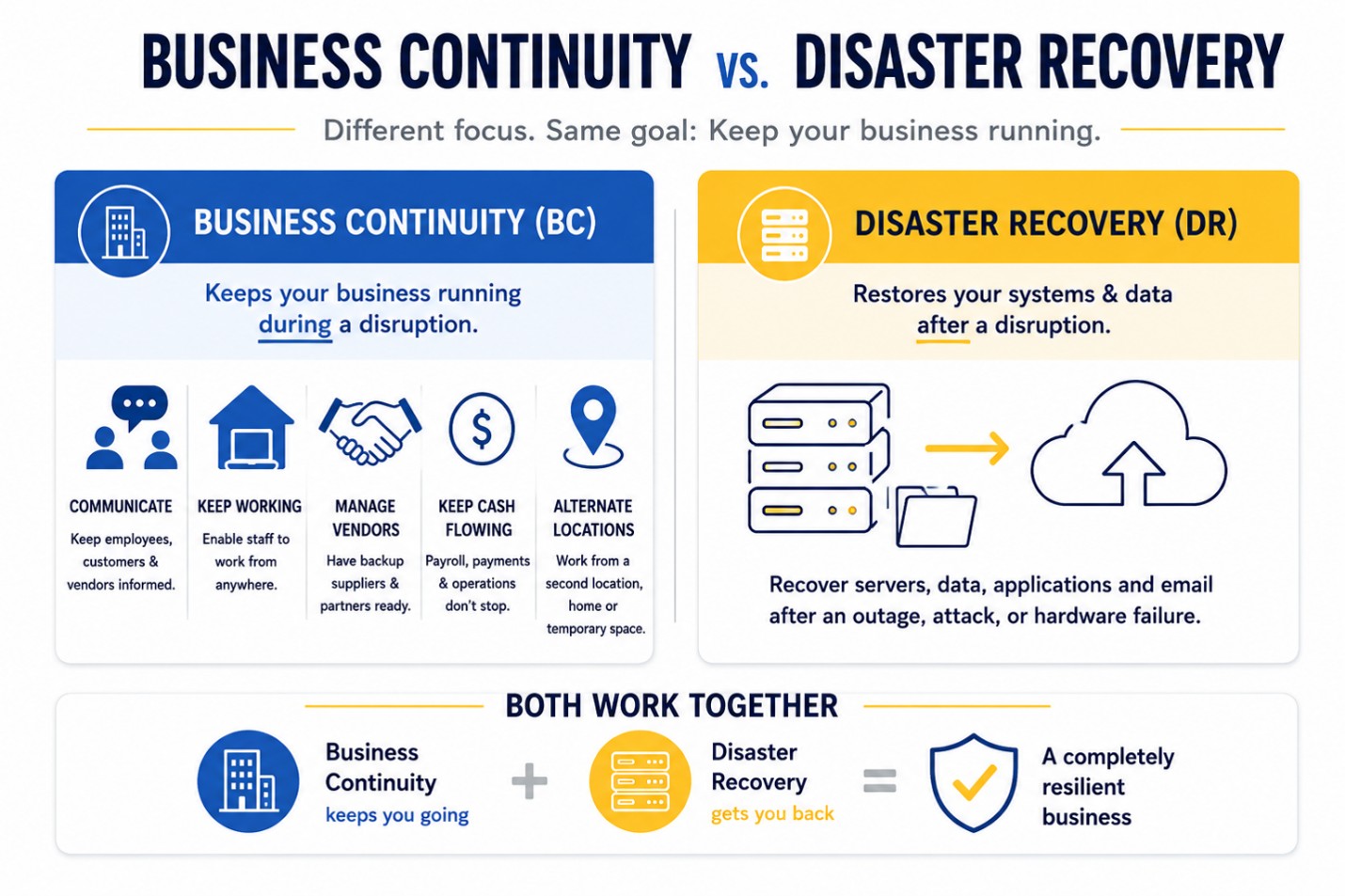
The two terms get used interchangeably, and that mix-up is exactly where plans fall short. Disaster recovery (DR) is the technical half — the steps that get your servers, files, applications, and email running again after an outage, ransomware attack, or hardware failure. It’s the part most IT conversations focus on, and it’s genuinely essential.
Business continuity (BC) is the bigger picture. It’s the plan for how the business itself keeps operating while DR is happening in the background — where employees work if the office is inaccessible, how customers get told what’s going on, which supplier steps in if your primary one goes dark, and how payroll still runs on Friday even if the system that normally processes it is down. DR is a subset of BC, not a replacement for it. You can have a flawless backup strategy and still lose the business if nobody’s thought through the rest.
Pro tip: If your building was inaccessible for a week — not your servers, the building — would you know what to do? That question usually reveals whether you have a continuity plan or just a recovery plan.
Why September Is a Good Time to Check This in New Mexico
FEMA and Ready.gov designate September as National Preparedness Month, and it’s a useful annual checkpoint even outside hurricane-prone regions. Albuquerque businesses face their own version of disruption risk: monsoon flooding, wildfire smoke closing offices or disrupting air travel, aging grid infrastructure during peak summer demand, and the same ransomware and business email compromise risks every business faces regardless of geography. A recent U.S. Chamber of Commerce Foundation survey found that most small businesses still have no disaster plan at all, despite record disaster costs nationally — confidence that they could recover doesn’t match actual preparation.
Pro tip: You don’t need a plan for every possible scenario. Start with the two or three disruptions most likely to actually hit your business, and build from there.
What a Real Business Continuity Plan Covers
Communication Plan:
Who notifies employees, customers, and vendors, through what channel, and who’s authorized to speak publicly if something happens. Decide this before you need it — not while it’s happening.
Alternate Work Arrangements:
Where and how staff work if the office is inaccessible for a day, a week, or longer.
Vendor and Supply Continuity:
Which vendors are critical to daily operations, and whether you have a backup option if a key supplier or partner goes down.
Financial Continuity:
How payroll, vendor payments, and basic cash flow keep moving if your primary systems or your bank access is temporarily disrupted.
Physical Location Contingencies:
A plan for operating from a second location, a home-based setup, or a temporary space if your primary office is unusable.
Alternate work arrangements depend heavily on already having secure remote access in place through solid cloud computing and remote-work infrastructure — this is much harder to stand up for the first time in the middle of a crisis.
How Continuity and Recovery Work Together
Think of disaster recovery as the engine and business continuity as the steering wheel. DR gets your data and systems back — this is where data backup and recovery planning does the heavy lifting. BC decides what the business does in the meantime and immediately after: who’s talking to customers while systems are down, whether staff can keep working from somewhere else, and how the business stays solvent during the gap. Neither one works well without the other. A business with a great backup strategy but no communication plan still looks disorganized and unreliable to customers during an outage. A business with a strong communication plan but no tested recovery process eventually runs out of things to say.
Pro tip: If you’ve already invested in a broader cybersecurity program or a tabletop exercise for your incident response plan, you’ve done some of this work already — continuity planning extends that same thinking beyond cybersecurity incidents to any kind of disruption.
Common Mistakes Businesses Make
Mistake 1 — Assuming a Backup Plan Is a Continuity Plan:
Backups solve the data problem. They don’t answer who talks to customers, where people work, or how the business pays its bills in the meantime.
Mistake 2 — Writing the Plan Around IT Only:
A real continuity plan involves leadership, HR, finance, and customer-facing staff — not just the technical team. Most disruptions test the whole business, not just the systems.
Mistake 3 — Never Testing the Non-Technical Parts:
Businesses that test data restores rarely test whether the communication plan or alternate work arrangements actually work in practice. Untested plans fail the same way whether they’re technical or not.
Mistake 4 — Treating This as a One-Time Document:
Staff turnover, new vendors, and new tools all make a continuity plan stale fast. A plan needs a scheduled annual review, not a permanent home in a drawer.
Frequently Asked Questions
It covers the technical restoration piece, but not how the business functions while that’s happening — communication, staffing, cash flow, and vendors all need their own plan.
Write it down. In a real disruption, people default to what’s documented, not what was discussed once in a meeting. A short, specific plan beats a long, vague one.
They overlap. A cyber incident response plan is really a continuity plan scoped specifically to cyber incidents. The same communication and role-clarity principles apply to any disruption — a power outage, a natural disaster, or a key vendor failure.
Both. LDD can lead the IT and recovery side directly, and help facilitate the broader planning conversation as part of managed IT services — but decisions like who speaks for the company publicly or how payroll gets covered ultimately need leadership at the table.
At least annually, and after any major change — new office, new key vendor, or significant staff turnover in a role the plan depends on.
Start small: identify your two or three most likely disruptions, and write down who does what in the first 24 hours of each one. If you’d like a second set of eyes on it, contact us and we’ll help you build it out.
Related Articles & Next Steps
→ Is Your Incident Response Plan Actually Going to Work?
→ Business Data Backup Testing: Can You Actually Restore?
Sources
- gov — Ready Business
- S. Chamber of Commerce Foundation — 94% of Small Businesses Say They Could Recover from a Disaster, but Only 31% Have a Plan
- Federal Trade Commission — This National Preparedness Month, Make a Plan for Your Business

David Luft
CEO, LDD Consulting
David founded LDD Consulting in 2003 with a straightforward mission: help small and mid-sized businesses in Albuquerque and across New Mexico get reliable, enterprise-quality IT support without the enterprise price tag. He holds an MBA with a concentration in Information Systems from the University of New Mexico, along with Microsoft Certified Systems Engineer (MCSE) and Microsoft Certified Trainer (MCT) credentials. He’s been solving business technology problems for more than 25 years.